

The current situation and development trend of forged aluminum wheels
Apr 27, 2025
Due to increasingly strict regulations on energy conservation and environmental protection, the development direction of the automotive industry in recent years has been dedicated to developing vehicles with low fuel consumption and low emissions. Among various measures to reduce fuel consumption, achieving automotive lightweighting is the top priority, and the main focus of lightweighting is set on the driving system.
Therefore, making efforts to adopt lightweight metal materials (aluminum, magnesium) and organic materials (polymer materials) in the walking system has become an effective measure to reduce the weight of empty vehicles.
 There are more and more examples of the use of aluminium as a lightweight structural material. At present, the average aluminium consumption of each car is 70 kilograms, accounting for approximately 6% of the empty weight of the car. Among them, the aluminum usage for the engine and transmission is 40 kg, for the walking system it is 18 kg, for the vehicle body it is 10 kg, and for the interior equipment it is 3 kg. According to the latest estimate, the consumption of aluminium in cars will reach 120 kilograms in the next few years.
Up to now, the use of light metal materials in automobiles has mainly been concentrated on the vehicle body, and the usage in rotating and vibrating parts is also increasing day by day. In terms of mass, wheels take the lead. By adopting lead wheels, not only can the energy consumption of the car during acceleration be reduced, but also a small tangential force can be achieved in the connection of the wheels to the vehicle body suspension. This is beneficial to the size, design, and quality of the vehicle body and the walking system. The reduced non-load mass due to the use of aluminum wheels has also incidentally improved the driving performance and comfort of the vehicle.
The use of aluminium wheels has a history of 20 years and has had a shocking effect on motorsport. In 1923, the racing cars made by Pugaqi Company were equipped with aluminum wheels cast by sand molds. After that, it took the German Mercedes-Benz Company three years to develop spoke-type aluminum wheels with welded aluminum wheels. The wheels were extruded, and this type of aluminum wheel was only used in racing cars.
Today, aluminium wheels have become original or optional parts for automobile manufacturers. Car wheels are mainly manufactured by low-pressure casting. Since the mid-1960s, the use of forged aluminum wheels in cars and cargo trucks has increased significantly. It is particularly worth noting that the aluminium wheels made by the aluminium forging technology developed by Otto Fuchs have been put into mass production and have been applied to Mercedes-Benz and Porsche cars.
The successful application of aluminum wheels lies first in the fact that they are lighter in weight compared with steel wheels and can meet their strict design requirements. In addition, due to the high thermal conductivity of aluminium, it can quickly dissipate the frictional heat generated by the tires. Thus, on the one hand, it can reduce the thermal load of the braking device, and on the other hand, it also improves the driving safety of the vehicle. Furthermore, the use of aluminium wheels will reduce the heat exposure of the tires, that is, it will reduce the compression work of the tires. Thus, it is conducive to reducing tire wear.
Modern automobiles have the following requirements for wheel systems: minimum mass, good static and dynamic strength characteristics, good corrosion resistance, good rotational performance, good thermal conductivity, good regenerative performance, unrestricted forming possibilities, excellent surface finish, and low price.
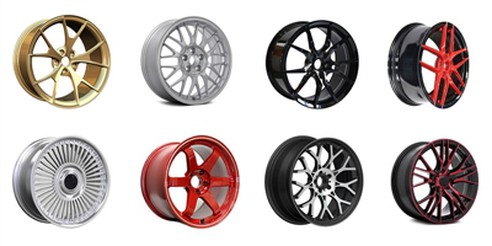
The determination of the wheel size of a vehicle should not only be based on the requirements of the vehicle under normal driving conditions, but also take into account the usage requirements under incorrect usage conditions and overload working stress, MPa conditions, especially the requirements for high-speed passage through poor road surfaces under low air pressure. To develop a wheel that is as light as possible, it is not only necessary to select low-density materials, but also to conduct performance tests on the materials. While having high static strength, it must also have good plasticity so that it can withstand loads through deformation under overload conditions. In addition, it should have good vibration resistance and corrosion resistance to achieve the necessary service life.


