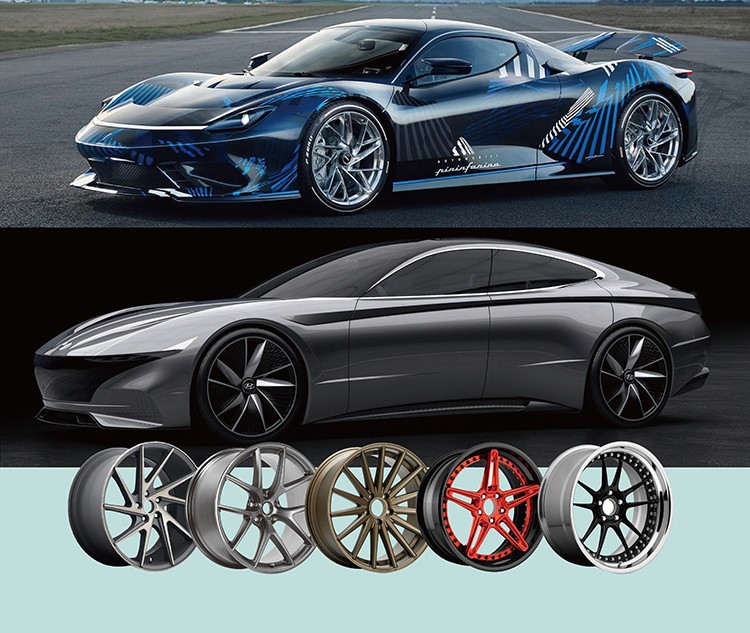
Wheels – a key element of automotive performance and aesthetics
May 14, 2026
As a core component connecting the car body to the road, the importance of automotive wheels far exceeds the perception of most car owners. They are not only the foundation supporting the vehicle's weight but also a key factor influencing driving safety, handling performance, and fuel economy.
Functionally, wheels undertake four core tasks: bearing vehicle loads, transmitting drive torque, ensuring tire cooling, and providing temporary support in the event of a tire blowout. A high-quality wheel must possess sufficient strength, rigidity, and fatigue life. Based on different manufacturing processes, wheels are mainly divided into two categories: cast wheels and forged wheels.
Cast wheels are the most common type, produced using gravity casting or low-pressure casting processes. Gravity casting is low-cost, but the metal may contain internal porosity, affecting strength; low-pressure casting injects molten aluminum into a mold under pressure, resulting in higher density and approximately 20% increased strength. Currently, 80% of original equipment wheels on the market use low-pressure casting. The advantages of cast wheels are controllable cost, diverse designs, and suitability for mass production.
Forged wheels, on the other hand, are the "elite" among wheels. Using a 10,000-ton forging press, aluminum ingots are forged in one go, resulting in complete metal grain lines and a strength 30%-50% higher than cast wheels, while reducing weight by 15%-25%. For example, a cast 18-inch wheel weighs approximately 11-13 kg, while a forged wheel weighs only 8.5-10 kg. This translates to a lower unsprung mass-every 1 kg reduction in the mass below the suspension system is equivalent to a 4-5 kg weight reduction in vehicle weight, improving handling. Reduced unsprung mass significantly improves suspension response, reduces road impact transmission, and allows the vehicle to maintain better contact with the road.